








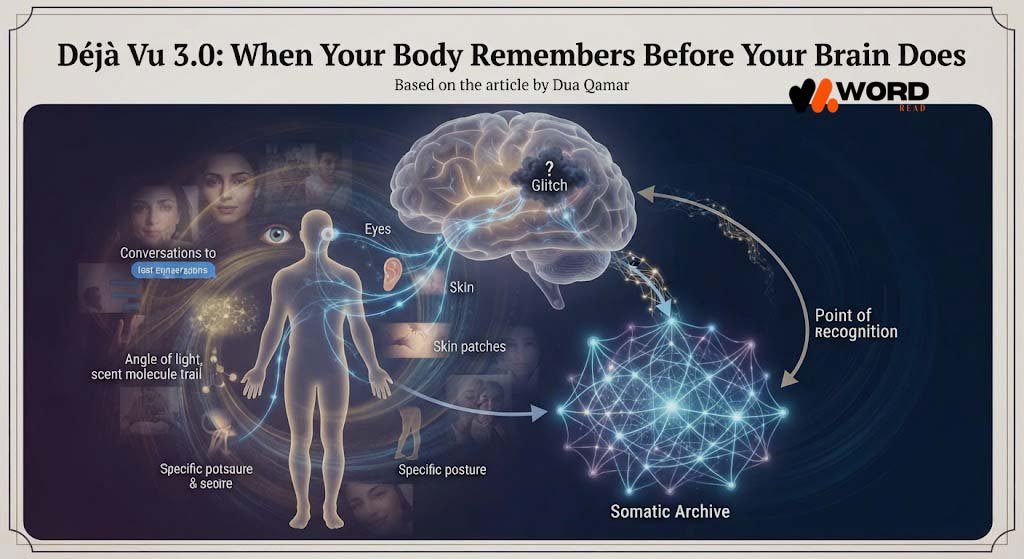
Déjà Vu 3.0: When Your Body Remembers Before Your Brain Does
You’re having a normal conversation or walking into a room you’ve never visited before, and suddenly — a jolt. A wave of certainty washes over you: this has happened before. The exact words, the angle of the light, the scent in the air — everything feels impossibly familiar. Then, just as quickly as it arrived, the feeling vanishes.
This is déjà vu, a French term meaning “already seen” . Up to 90% of adults have experienced it at least once . For most, it’s a fleeting curiosity. But what if that eerie familiarity isn’t just a brain misfire? What if it is your body detecting something your conscious mind hasn’t yet processed? Welcome to Déjà Vu 3.0, where the body remembers before the brain catches up .
The Science of the Glitch

For years, scientists dismissed déjà vu as a harmless memory error. Three main theories now dominate our understanding of this phenomenon.
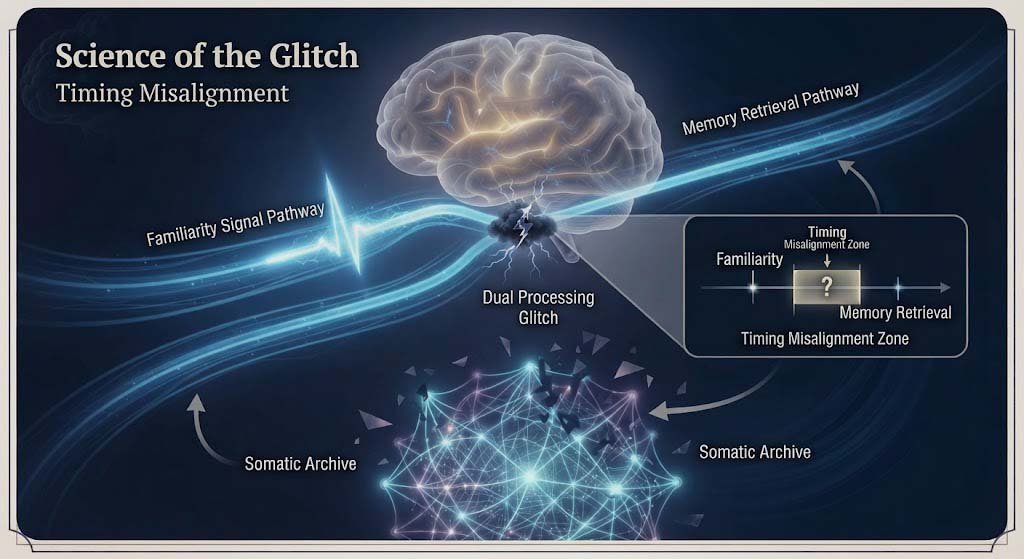
The Dual Processing Glitch suggests that two parallel cognitive pathways — one that generates a “familiarity” feeling and another that retrieves actual memories — sometimes fall out of sync .
When the familiarity signal fires a fraction of a second before the retrieval process confirms the memory, your brain is left with a powerful feeling of recognition that it cannot explain. It perceives a “timing misalignment.”
The Pattern Recognition View proposes that your brain’s pattern-matching system might be overly efficient . If the layout of a new room or the structure of a conversation resembles something you’ve experienced before, your brain may incorrectly flag the entire scene as familiar. It is not a memory error; it is a miscalculation based on recognising fragments.
The Neural Spark Theory offers a physiological explanation: a brief, harmless burst of electrical activity in the brain’s temporal lobe , which is crucial for memory. This micro-seizure creates a false sense of recollection,
fooling you into believing you are accessing a memory when, in reality, it is just a neural misfire. Clinical studies have shown this sensation can be induced in patients by stimulating these specific brain regions .
The Body Remembers
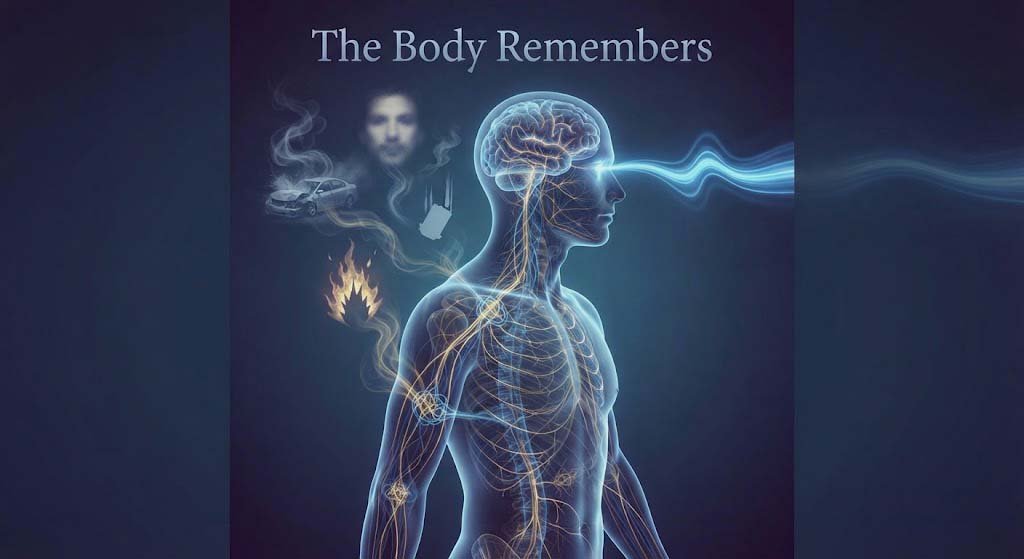
While these theories explain the experience from the brain’s perspective, they often overlook a critical component: you are a whole person, not just a brain. This is where the body enters the picture.
The idea that the body holds onto experiences the conscious mind has forgotten is central to understanding what I call “Déjà Vu 3.0.” In his seminal book The Body Keeps the Score,
Dr. Bessel van der Kolk explains that when we experience overwhelming events, the memory is stored not as a coherent story, but as a collection of sensory fragments — images, sounds, smells, and physical sensations — often without a clear narrative . The body remembers, even when the mind “forgets” . This is known as somatic memory or implicit memory .
These memories are pre-verbal. An infant who experiences trauma cannot form a linguistic memory of the event. Instead, their body encodes the survival response — the tension, the fear, the visceral reaction . These physiological blueprints lie dormant until triggered by a specific sensory cue in the present.
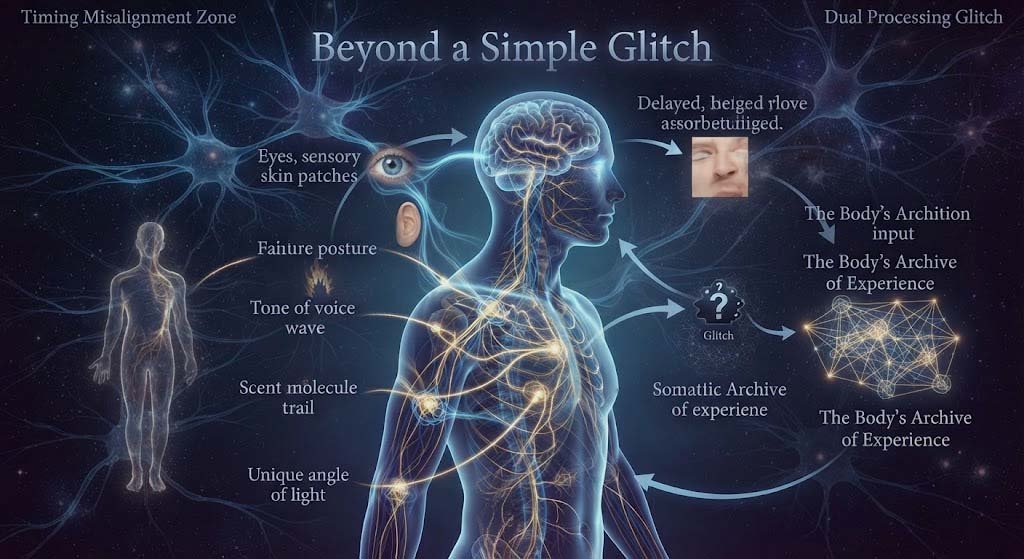
The Body’s Déjà Vu
This is where it all connects. That sudden, inexplicable familiarity you feel when you walk into a new room could be your body saying, I know this pattern, before your brain has time to form a coherent thought. It is not a glitch; it could be a somatic echo.
Your body’s “memory” is built from countless non-conscious experiences: a certain posture, a specific tone of voice, a particular smell.
When you enter a situation where the sensory “shape” of the environment matches one of those unconscious patterns — even if the conscious details are brand new — your body may react with a burst of recognition before your neocortex can provide a logical explanation .
As one perspective puts it, your body might be “remembering” the spatial structure of a place before your brain confirms the details . It is a “timeline correction” or “functional misjudgment” .
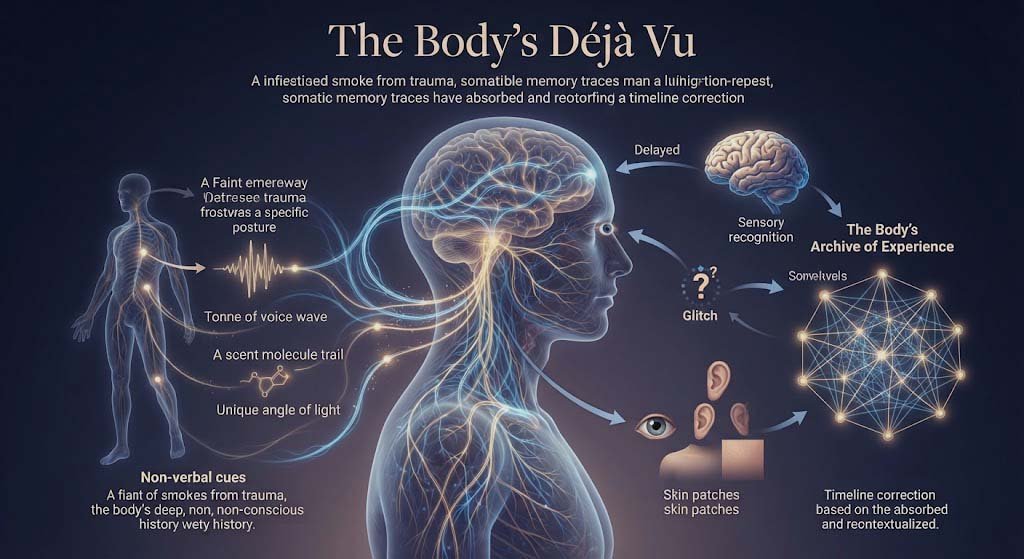
Beyond a Simple Glitch
Déjà Vu 3.0 reframes an old mystery. It invites us to consider that the feeling of “already seen” might sometimes be “already felt.” It is not about remembering a past life or a parallel dimension, but about recognising a pattern that your conscious, narrative brain hasn’t yet grasped. It is your body’s archive of experience momentarily bleeding into your present awareness .
In that moment, before the memory centres of your brain can catch up, your body might just be reminding you that it has been here before.
About the Author
My name is Dua Qamar, and I am a content writer fascinated by the intersection of psychology, neuroscience, and the everyday mysteries of human experience.
I believe that some of the most profound questions about consciousness are hiding in plain sight — in moments like déjà vu that we dismiss as trivial. My goal is to explore these hidden layers and make complex ideas accessible and engaging for curious readers.
Why I Wrote This Article:
I wrote this piece because the experience of déjà vu is universal, yet we rarely stop to consider what it truly reveals about the connection between mind and body.
The idea that our bodies might be holding memories that our brains haven’t yet processed is both unsettling and fascinating. I wanted to explore how scientific theories of memory, trauma, and perception can come together to offer a more holistic understanding of this curious phenomenon.
How I Approached This Topic:
My research drew on a range of sources, from cognitive psychology and neuroscience to the study of somatic memory and trauma. I synthesised these insights to present a new lens through which to view déjà vu — one that respects both the neurological “glitch” theories and the idea of the body as an archive of experience.
Who This Article Is For:
This article is for anyone who has ever felt that strange shiver of familiarity in a new place and wondered what it really means. It is for the curious, the introspective, and those who are open to the idea that our bodies know more than our minds can explain.
The Message I Hope Readers Take Away:
Déjà vu is not just a brain hiccup. It is a conversation between your body’s stored history and your present awareness. The next time you feel it, pause. Your body might be trying to tell you something your conscious mind hasn’t yet noticed.
Written by: Dua Qamar


