










Instagram Back Pain: The New Health Problem from Scrolling Too Much
We all know the posture. You’re curled up on the sofa, phone in hand, thumb gliding upward through an endless stream of reels. An hour passes. Maybe two. Then you try to straighten up, and a sharp twinge in your neck or lower back reminds you that your body has been frozen in a question mark shape for far too long.
Welcome to the modern world’s newest health epidemic: Instagram back pain.
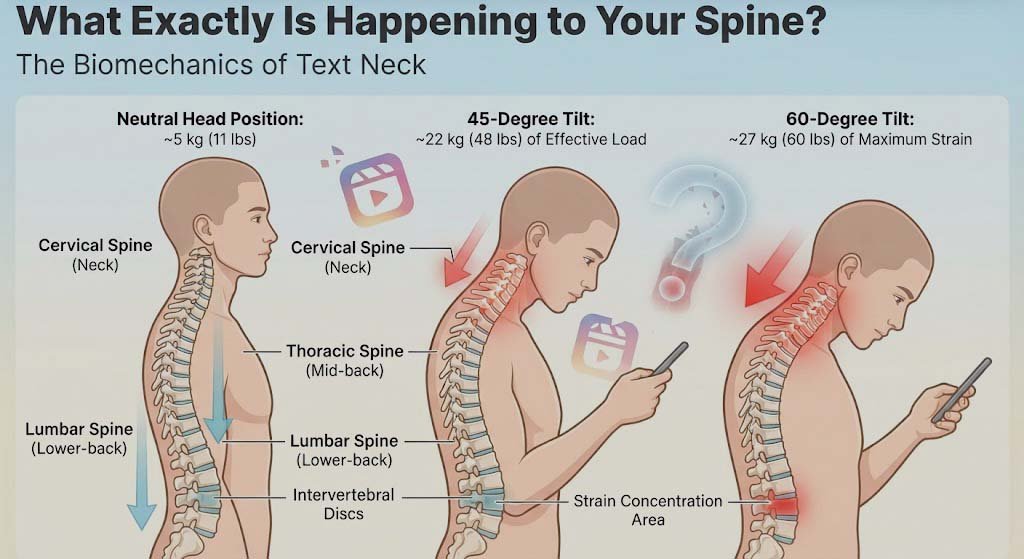
What Exactly Is Happening to Your Spine?

The problem has a name—”tech neck” or “text neck”—and it’s becoming one of the most common lifestyle disorders among young adults and teenagers . But what’s actually going on inside your body when you scroll?
The human head weighs about 4.5 to 5.5 kilograms in a neutral, upright position .
Your neck can support that just fine. But tilt your head forward to look at your phone—say, at a 45-degree angle—and the effective load on your cervical spine jumps to roughly 20 to 25 kilograms . That’s like carrying a large suitcase or a baby around your neck all day .
At a 60-degree angle, the strain can reach nearly 27 kilograms . Multiple studies using radiographic imaging have confirmed that smartphone use significantly alters cervical spine alignment, particularly in the upper segments where the vertebrae are smaller and the musculature is weaker .
The seated posture—the way most of us scroll—is actually worse than standing because it encourages slouching, creating a longer moment arm and increased shear forces on the spine .
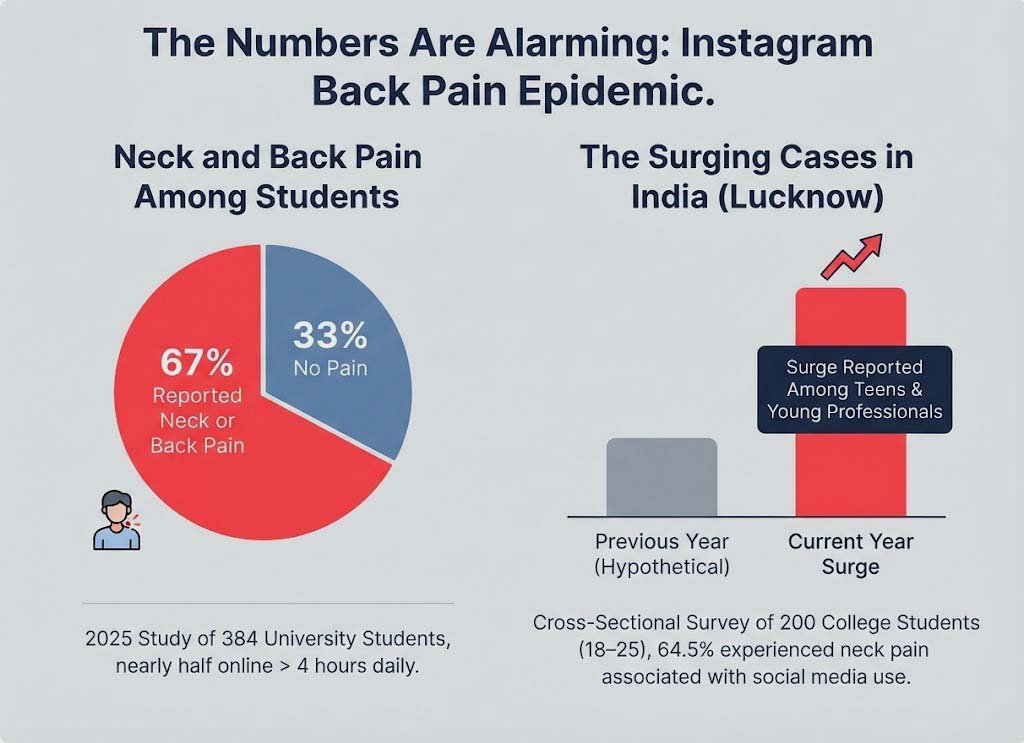
The Numbers Are Alarming

This isn’t a niche problem. A 2025 study of 384 university students found that 67% reported neck or back pain linked to their digital habits, with nearly half spending over four hours online daily . Another cross-sectional survey of 200 college students aged 18–25 revealed that 64.5% experienced neck pain associated with prolonged social media use .
In Lucknow, India, doctors are reporting a surge in cases among teenagers and young professionals. One 23-year-old patient who spent 7 to 8 hours daily watching reels was diagnosed with a misaligned cervical spine .
Orthopaedic surgeons warn that excessive scrolling can lead to disc damage, nerve compression, flattening of the natural neck curve, and early degenerative changes .
The irony is that social media is designed to keep us scrolling, and our bodies are paying the price. Physiotherapists point out that the average person sits for 9.2 hours a day, and smartphones add to the problem by keeping us in a constantly forward-flexed posture . The chest muscles and hip flexors stay shortened and tight, while the back muscles weaken from disuse .

The Good News: It’s Reversible
Tech neck is reversible if you take action before it becomes chronic. Small, straightforward changes can have a big impact:
Raise your screens. Position your phone or laptop at eye level rather than craning your neck downward. A laptop stand—or even a simple stack of books—can make a real difference.
Take screen breaks. The 20-20-20 rule is a good start: every 20 minutes, look at something 20 feet away for at least 20 seconds .
Stretch it out. Gentle neck stretches, shoulder rolls, and the classic “chin tuck”—pull your chin straight back to create a double chin, hold for 10 seconds, repeat five times—can release built-up tension .
Strengthen your muscles. Light exercises like chin tucks, wall angels, and yoga poses can strengthen the muscles that keep your posture upright .
Move regularly. Our bodies crave variety. Even small “movement snacks”—standing up, changing your sitting position, walking while on a call—can counteract the effects of prolonged sitting .

The Bottom Line
Scrolling Instagram isn’t going away anytime soon. But the way we scroll can change. The next time you catch yourself hunched over your phone, neck craned forward, back aching, remember: your future self will thank you for sitting up straight.
About the Author
My name is Dua Qamar, and I am a content writer fascinated by the intersection of technology and human health. I believe that understanding the hidden costs of our digital habits is the first step toward reclaiming our wellbeing.
Why I Wrote This Article:
I wrote this piece because “Instagram back pain” is one of those modern problems that nearly everyone experiences but few talk about seriously. I wanted to explore the science behind the ache and offer practical solutions.
How I Approached This Topic:
My research drew on recent studies published in peer-reviewed journals, reports from orthopaedic surgeons and physiotherapists, and clinical data on postural health and screen time.
Who This Article Is For:
This article is for anyone who has ever felt a twinge in their neck after a long scrolling session—and wondered if it was just them.
The Message I Hope Readers Take Away:
Your body is not designed for endless scrolling. Small changes in how you hold your phone and how often you move can protect your spine for years to come.
Written by: Dua Qamar


