
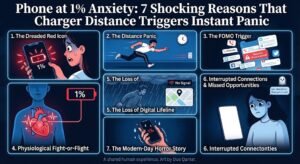








Your Phone is at 1% and the Charger is Too Far Away… Instant Anxiety
Introduction
We’ve all been there. That sinking feeling when you glance at your phone and see the battery icon flashing red at 1%. You frantically look around for a charger, but the nearest outlet is across the room, or worse, in another room entirely. The clock is ticking, and the panic begins to set in.
For many, this is more than just an inconvenience—it’s a genuine source of anxiety. This modern affliction, often referred to as “low battery anxiety” or “nomophobia” (the fear of being without a mobile phone), is a growing concern in our hyper-connected world. The moment your phone hits 1% and the charger is out of reach, a wave of unease, worry, and even dread washes over you. But what exactly is this feeling, and why does it have such a powerful grip on us?


The Psychology of Low Battery Anxiety
The anxiety experienced when your phone is about to die is a documented phenomenon. Experts suggest that our phones have become extensions of ourselves—digital lifelines to the world, our social networks, our work, and our essential information . When the battery is critically low, it feels like our connection to the world is about to be severed.
This feeling is amplified by the “fear of missing out” (FOMO). We worry that if our phone dies, we will miss an important message, a crucial email, or a post from a friend . In a world where being connected is the norm, the thought of being unreachable can cause significant distress.
Research by the University of California, Irvine, found that many participants experienced immediate anxiety when their phones were not accessible . For some, this fear is so severe it can lead to a condition called “nomophobia,” which has been linked to heightened levels of stress and depression . The irony is that the very devices designed to make our lives easier can become a source of intense anxiety.

The Physical and Emotional Response
The anxiety triggered by a dying phone is not just psychological; it has physical symptoms. You might experience an increased heart rate, sweaty palms, or a tightness in your chest . Your mind races as you calculate the distance to the charger and the urgency of the next text message. This reaction reflects the classic “fight-or-flight” response triggered by a perceived threat.
A recent study highlighted that 75% of Americans actively worry about their phone dying while away from a charger, and this fear, especially among the younger generation, can be so consuming that it affects their daily lives and even their mental well-being . The thought of having to navigate or communicate without your phone has become a modern-day horror story.

The Comedy of It All: A Shared Human Experience
Despite the genuine panic, there is something undeniably comedic about this situation. We have all made the frantic dash to the charger, or attempted to conserve the last 1% by putting our phone in “ultra power saving” mode . It is a shared human experience that unites us all.
In fact, this shared experience has spawned countless memes and jokes online. One comedic writer perfectly captured the sentiment: “Your phone is at 1% and the charger is far away—instant anxiety. Also, your crush is texting you, you’re waiting for an important email, and your Uber is arriving in 5 minutes” . Another joke puts it this way: “If you’re at 1% and the charger is far away, it’s not a race to charge—it’s a race to find the will to live,” underscoring the desperation of the moment.

Coping Strategies: How to Survive the 1% Countdown
So, what can you do when you find yourself in this predicament? Here are a few strategies:
The Sprint: The most obvious solution—run to the charger as fast as possible, hoping the phone doesn’t shut down mid-stride.
The Power Nap: Turn off all unnecessary apps and put your phone into low-power mode to squeeze out every last second of life.
The Sacrifice: If you are with friends, ask to borrow their charger. Yes, you will have to admit your battery is dying, but that is a small price to pay for digital survival.
The Acceptance: Sometimes, you just have to accept that your phone is going to die. It can be liberating to disconnect for a while. However, at 1%, this is a hard pill to swallow.
Conclusion
The “1% battery anxiety” is a modern phenomenon that perfectly encapsulates our era. It highlights our deep dependency on technology and the constant anxiety of being disconnected. So, the next time you see that red battery icon, take a breath. It’s a shared human experience, a moment of comedy, and a reminder that your phone—and your anxiety—can be put down for a while.
About the Author
My name is Dua Qamar, and I am a content writer who believes in finding the humour and relatability in our everyday experiences. I am fascinated by the intersection of technology and human psychology, and I love writing about the quirks of modern life.
Why I Wrote This Article:
I wrote this piece because the “phone dying at 1%” is one of the most universally relatable experiences of the 21st century. It is a small but powerful moment of panic that nearly everyone understands. I wanted to explore the psychology and humour behind this shared anxiety, and maybe provide a little reassurance that we are all in this together.
How I Approached This Topic:
I researched this topic by drawing on expert analysis of modern technology anxiety, psychological studies on smartphone addiction, and the wealth of comedy memes that have been created around this exact situation.
Who This Article Is For:
This article is for anyone who has ever made a dash for a charger, or who has ever felt that pang of fear when they saw their battery hit 1%.
The Message I Hope Readers Take Away:
The anxiety of a dying phone is a genuine feeling, but it is also a sign of our times. Learning to cope with it—whether by planning ahead or taking a moment to breathe—can help us better manage our relationship with technology.
Written by: Dua Qamar


