
Google Gemini Free Plan 2026-2027: What You Actually Get Without Paying
If you have been following the artificial intelligence space, you already know that every major tech company wants you to subscribe to their premium AI service. Google is no different with Gemini. But here is the reality that often gets buried beneath the marketing hype. The free version of Gemini has become genuinely useful, and for many people, it is more than enough.
How Gemini Started
Google introduced Gemini in late 2023 as the company’s response to the growing demand for advanced conversational AI. It was designed to be multimodal from the ground up, which meant it could process not just text but also images, audio, video, and code simultaneously. This was a departure from earlier Google AI projects that handled different types of data separately .
The early versions of Gemini were impressive, but they came with significant limitations for free users. The context window was much smaller, image generation capabilities were limited, and access to the most powerful models was restricted. Over the past two years, however, Google has steadily expanded what free users can access, and the pace of improvement has accelerated dramatically .
What You Get for Free in 2026
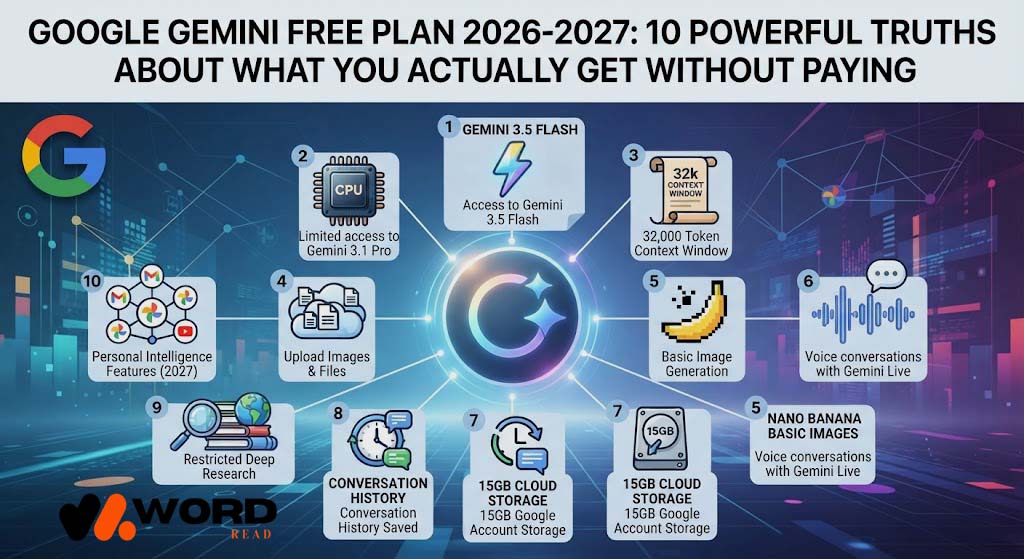
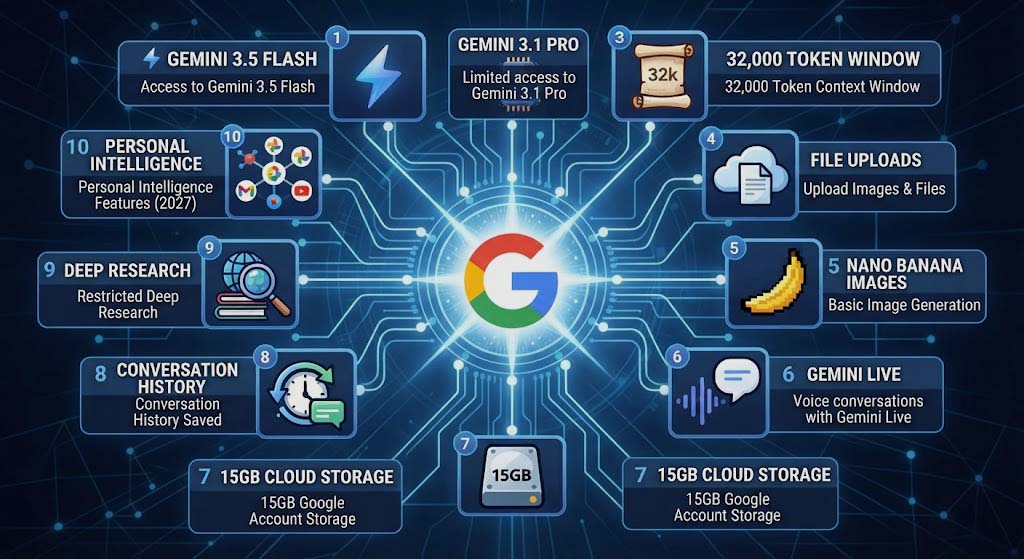
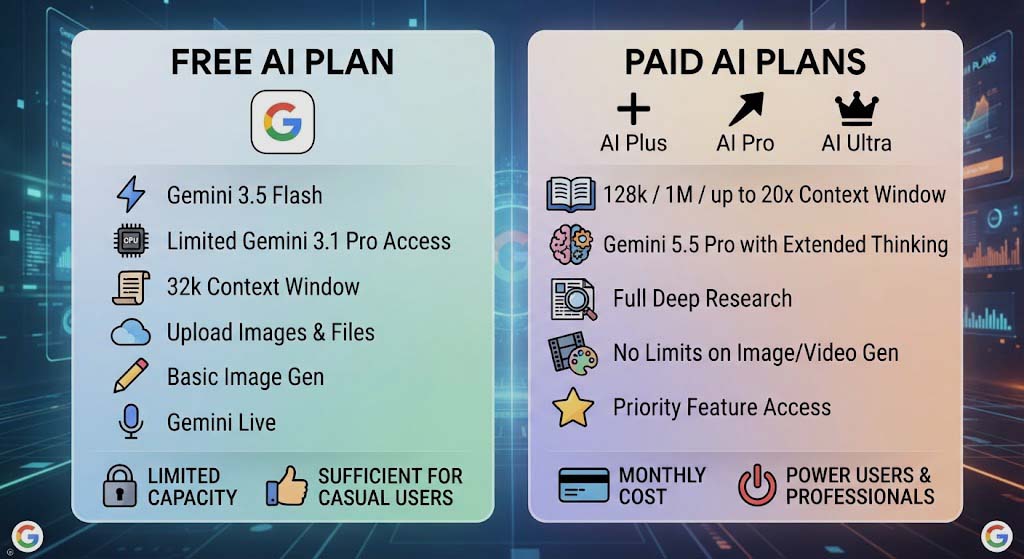
The free tier of Gemini is officially called Google AI Free, and it includes access to the Gemini 3.5 Flash model. This is Google’s fastest model designed for quick responses to straightforward queries. Free users also get some access to Gemini 3.1 Pro, which is more powerful and suited for complex tasks, but with stricter daily usage limits .
The free plan gives you a 32,000 token context window, which is enough for handling moderately long documents or extended conversations. You can upload images and files for analysis, generate basic images through Nano Banana features, and access Gemini Live for voice conversations . Your Google account also comes with 15 gigabytes of cloud storage through the free plan .
Conversation history is now available to free users as well. Previously a paid feature, Gemini can now remember your past interactions and provide more personalized responses based on what you discussed earlier. This can be turned on or off through settings, and Google has emphasized that privacy controls remain transparent .
For research tasks, free users have access to Deep Research, which searches across websites and provides detailed reports with citations. However, usage of Deep Research is severely restricted compared to paid tiers .
Where the Free Version Falls Short
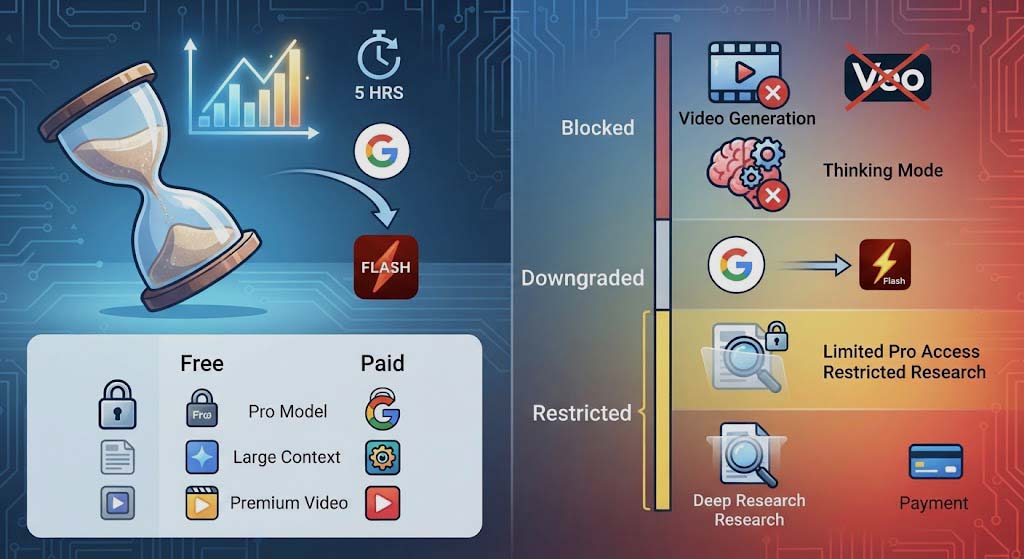
The limitations of the free plan become obvious if you use Gemini regularly. Google uses a dynamic limits system that does not give you a fixed number of queries per day. Instead, your usage limits depend on the complexity of your requests, the model you are using, and current system load . The limits reset every five hours, but once you hit your limit, you are downgraded to a lower model until the next reset cycle .
Free users have only low access to the Thinking mode, where Gemini works through problems step by step before giving an answer. Your daily prompts for Pro mode are limited to a handful before the system automatically switches you to the Flash model . This can be frustrating if you are working on something that requires Gemini’s best reasoning capabilities.
Video generation is practically nonexistent for free users. Access to Veo, Google’s premium video generation model, is blocked entirely. You may get a few trial generations, but it is not a consistent feature for free accounts . The Gemini 3.1 Pro model, which is substantially better at complex document analysis and coding tasks, is also heavily restricted .
Upgrading Options
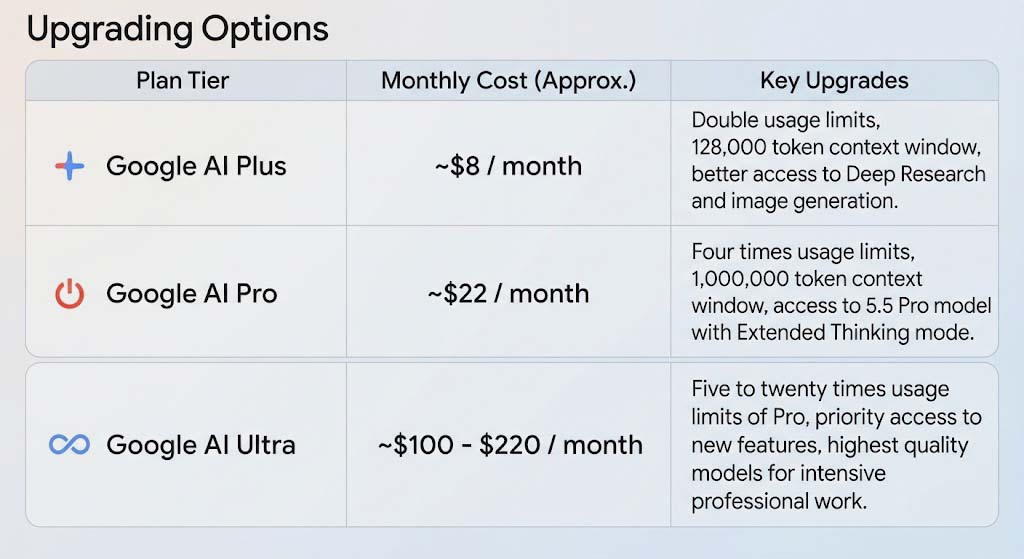
If you find yourself hitting the limits too often, Google has four paid plans structured differently.
Google AI Plus costs around eight dollars per month and gives you double the usage limits of the free plan. The context window expands to 128,000 tokens, and you get better access to Deep Research and image generation. This is the tier for regular users who need more capacity without going all in on premium features .
Google AI Pro runs about twenty-two dollars per month and offers four times the free plan’s limits. The context window jumps to one million tokens, which is enough to process entire books or large codebases. Pro users also get access to the 5.5 Pro model with Extended Thinking mode, which delivers Gemini’s most advanced reasoning capabilities .
At the top end, Google AI Ultra starts at around one hundred dollars per month and goes up to roughly two hundred twenty dollars for the highest tier. These plans offer five to twenty times the usage limits of Pro, priority access to new features, and the highest quality models for intensive professional work .
What Is Coming in 2027
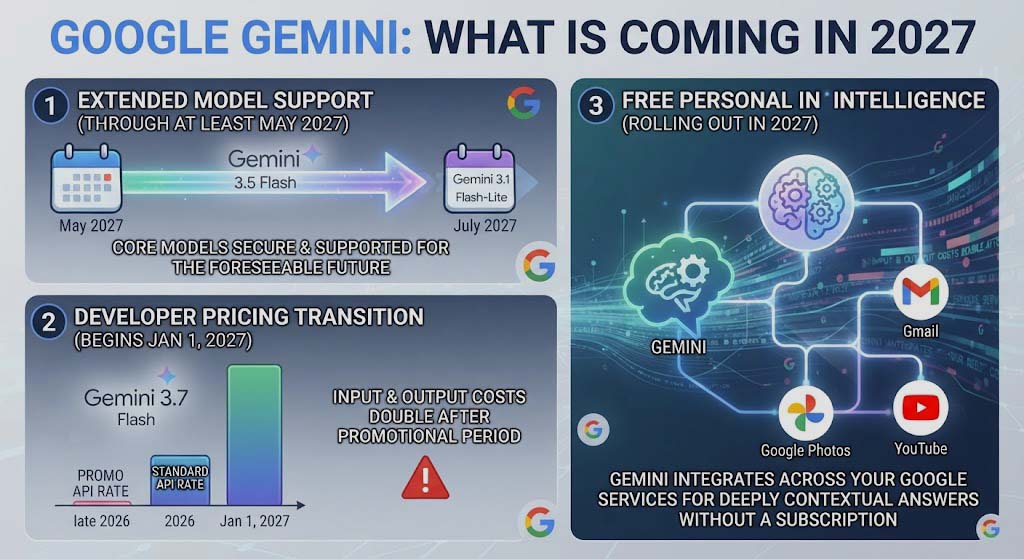
Google has already set clear dates for the Gemini model lifecycle. The Gemini 3.5 Flash model will remain available through at least May 2027, and Gemini 3.1 Flash-Lite is supported until July 2027 . This gives users confidence that the core technology will continue working for the foreseeable future.
The Gemini 3.7 Flash model, released in August 2026, is priced at half the usual API rate until January 1, 2027. After that, input costs double to 1.50 dollars per million tokens and output costs to 7.50 dollars per million tokens . This suggests a broader transition in 2027 where Gemini may become more expensive for developers, potentially making the free consumer tier even more valuable.
Google has also announced that personal Intelligence, a feature connecting information across different Google services, will roll out to free users without requiring a subscription. This feature allows Gemini to provide more contextual answers by tapping into your Gmail, Google Photos, and YouTube history, assuming you enable it .
Should You Upgrade
The answer depends entirely on how you use Gemini. If you have occasional conversations, need quick answers, or just want to experiment with AI capabilities, the free plan is sufficient. It is also excellent for students who need help with homework or brainstorming ideas .
If you work with AI daily and consistently hit usage limits, or if you need the best reasoning capabilities for coding, research, or document analysis, upgrading makes sense. The Pro plan is the sweet spot for power users, while Ultra is only justifiable for developers, content creators, and people building production systems .
The free version of Gemini in 2026 is more capable than paid versions from a year ago. Google has made genuine improvements to what users get without spending anything, and the upcoming features for 2027 suggest this trend will continue. The question is no longer whether you should use Gemini. It is whether you need to pay for it.
